
Democracy restored in Europe
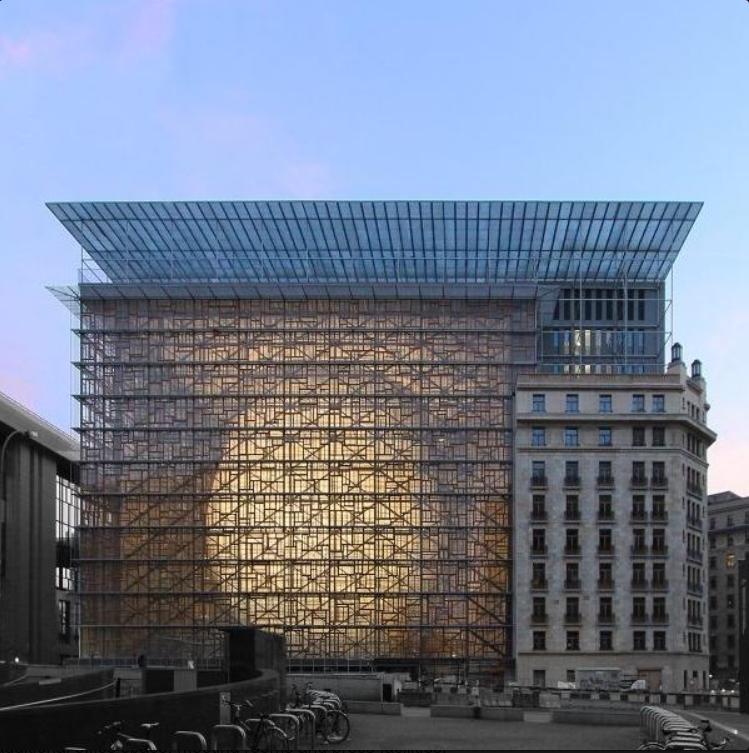
Europe Palace Photo: Samyn and partners – Own work, CC BY-SA 4.0
Brussels, October 28 2028, 10:00 a.m.
In the northern part of Brussels, a door slides open. A strange vehicle turns onto the road with a lot of rattling and drives towards the center. It looks like a kind of carnival float, hung with large gray cloths. It moves slowly through the streets to the Europe Building. On the sides it says in four languages: “Follow me”. The same thing is happening at four other locations around the center. In the streets around the palace, barricades appear to be erected that are quickly pushed aside by the MP’s on duty to allow the vehicles to pass.
Arriving at the Europe Palace[1] it appears that the necessary activity has been developed there. A mobile stage has been folded out and cameras are visible in various places that indicate a newsworthy event. Just before the mysterious vehicles line up around the building, four limousines arrive. Exactly at 10:45 a.m., four men get out. Three men in gray tunics ascend the stage where the image of a meeting room is now visible on a large screen where the heads of government of the EU are meeting.
A side door opens, and the fourth person enters the meeting room. The government leaders look up in surprise. When the chairman – Macro Merz – is preparing to ask ‘What’s the meaning of this’, the person who has just entered gestures him to sit down. Stunned, he does so.
Alice Musk walks to the lectern that has been quickly set up and takes the floor.
“Dear EU Heads of Government: This is a coup d’état.
An international committee has jointly decided that it is time for a real European government and European parliament. We can no longer tolerate your bungling, indecision and lack of leadership. It is our firm conviction that, if we continue on the current path, Europe will lose out in the world and become a backward area of poverty.
Actually, we should not call this a power grab, because that would mean that there is power that can be seized. The problem is that this power is lacking and your assembly serves other powers instead of the European citizens. To convince you, I ask you to take a look at this screen.”
A large screen was wheeled into the room showing the avenue in front of the building. Meanwhile, a large crowd had gathered there. The cloths had been removed from the five vehicles. They turn out to be army tanks, painted in pastel shades, the guns of the tanks aim threateningly at the Europe Building. Shots follow, scattering a large amount of confetti and paper flowers above the crowd.
Alice continues.
“We have no bad intentions. It is not our intention to establish a dictatorship. Although your behavior has been treasonous, we will not arrest you, as long as you cooperate.
We want a democratic Europe. A Europe that knows and defends its interests and the interests of its citizens. A Europe that doesn’t perish under the leadership of a bunch of so-called government leaders rolling over each other to serve international powers. I ask you to sign the declaration that will be submitted to you shortly.
For the record, these images can be seen live on many TV channels in Europe and on the internet. It will also be clear to you that this action is only possible with the cooperation of many parties, including secret services. The fact that I am standing here, without any of you knowing about it in advance, speaks for itself.
We will form and lead an interim European government. That government will draw up a European constitution and organize European elections within two years. I will now give the floor to Giorgia Orban, who will explain our plan in detail.’
On the large screen the stage on the square becomes visible. Giorgia Orban takes the stage. A screen shows the heads of government in the Europe Building. Orban organizes her papers and gets started.
Citizens of Europe, heads of government of the EU member states in the Europe Building. I will not tire myself with explaining the shortcomings in the years of costly floundering that must pass for European governance. Any citizen who has paid attention can easily come up with this themselves and the great harm that this has caused. Instead, I will outline a new and democratic Europe for you.
First of all, we will have to define new borders. Participating countries in the EU have too different views on taxation, economic policy, justice and so on to form a viable whole. The clientelism that characterizes the governance of countries that I will refer to as the periphery spread to the rest of Europe. It infected the European institutions and thus made an important contribution to the powerlessness, inertia and ineffectiveness of the EU, and had a negative impact on the European feelings of the citizens of the core countries.
New Europe needs to become a powerful state. We can no longer stand idly by, while production is carried out elsewhere in the world under very different working and environmental conditions, outcompeting the products made in Europe. The fact that the EU has decided to spend money of the working citizens to accommodate the inflow of unproductive migrants makes this even worse. We will have to think more carefully about the distribution of the fruits of technological development. Especially the distribution of high technology, to prevent this from falling into the hands of countries and groups that do not deal with them according to our standards, although I fear we are too late.
International issues such as the too cheap transport system, the problematic way in which raw materials are traded and the chaotic non-organization of the internet also require attention in this context. We can only make a very modest start in these areas in the coming years.
With the current collection of countries, a viable Europe is not possible. This doesn’t mean that we do not feel any obligation to our European brothers. But there can be no question of full participation in a federation for the time being. A considerable effort will be required to maintain peripheral status and to finally join the New Europe. My government will propose which countries cannot become an integral part of the European Federation and how the relationship with those countries will be shaped.
The nation states that we want to include in the core will not escape painful adjustments. A good and cohesive Europe is inconceivable if a number of its members can call the shots unilaterally by virtue of their weight and power. We will have to look for a structure in which those states participate in Europe in parts. A number of these divisions are obvious. German states, alone or in groups, will become members of the EF directly. We will do our best to include Great Britain in separate parts. The Heineken plan (1992) could be an indication. For some regions this will mean an increase in the autonomy they have been striving for for some time. We will urge Switzerland and Norway to join the new Europe. As it is impossible that Paris is not the capital of France, Berlin not the capital of Germany and London not the capital of Great Britain. There will be coordinating bodies – a kind of sub-federations – that have limited agency, mainly about culture and education.
***
Restoration of proper citizenship is an important goal. For years the governments of EU states have given away citizenship to large groups of migrants that don’t comply with minimal standards of citizenship. Even worse, a substantial group of these people don’t even want to be part of our culture and should be classified as foes of European, Western culture. They have actively refused to meet this minimum and have raised children in their own way, so they too didn’t meet these standards too. Allowing this should be seen as treasonous politics.
Probably the only way to solve this is to assign special areas where they will have to live with their own under strict and more primitive conditions. Isolated from their homeland and communication abroad. As long as they don’t cooperate to return to their homeland.
At the same time European states have suppressed the peoples of Europe. Not only by allowing this migration, but with policies that severed the social cohesion that was already below level to sustain the future of the demos. Individualism was promoted; marriage became a business contract that could be easily broken and was not aimed at a steady relationship between man and wife to raise children. Starting a family became practically impossible, certainly when one wanted to raise children in the own nuclear family. The bond between generations became completely broken.
To restore proper citizenship, the way the people are governed will have to be reorganized. First of all, the ‘rule of law’ should be restored.
The proliferation of ever more laws that get more detailed, are often changed and inconsistent, makes judges simple clerks instead of functionaries that have enough agency to separate right from wrong. It opens countless possibilities to shop around and select the articles that fit the political inclination of the judge. In fact, government was handed over to the juridical caste and parliamentary activities became a farce. It will be a nearly impossible but absolutely necessary task to rewrite the book of law in its totallity and reform the juridical caste. Judges should be held accountable like everybody else. They are not gods. This will take a few years, during which a kind of state of emergency will be necessary. But not a lawless and undemocratic state of emergency. I refer to the way these problems were solved after World War II.
The following matters will be organized or at least harmonized at European level as soon as possible:
- The income, inheritance and wealth tax, business taxes and VAT.
- Tolls, transport and energy taxes, subsidies and excise duties.
- The army
- Foreign policy, including all treaties and representations.
- One currency, the (New) Euro
- Legislation on Legal Entities and Trading Conditions.
- Employment law, including dismissal law.
- One border
- One European central bank.
- One air traffic management
- One pension system
- One judycatory
Of course, within this framework there will be enough opportunities for regional differences. One size fits all would be a terrible idea.
New Europe will have to be a fortress. We understand the wishes of many outside Europe to come here. Yet they will have to face the problems in their own country themselves, instead of coming here. A foreign policy must be shaped on the basis of this idea. Without the illusion that this is a task that can be accomplished easily with money or military intervention, although this may be necessary under some circumstances.
Military and police will have to be thoroughly reorganized and reeducated to defend the social order and the federation, instead of suppressing the citizens and being used for policing outside the federation. Robotization of policing and the military should be halted and even undone wherever possible. Agency of citizens to defend themselves should be strengthened.
Language is a point of special attention. For a federation to be able to function as a unity, there will have to be unity in language. National and regional languages will continue to play their role in the daily life of the regions. Federal bodies and legislation should only use a maximum of three languages. One of those is the primary language that most officials, also in the lower straits of national and rural governments must master at a reasonable level. Even citizens should be required to be able to read and understand government publications that will only available in one or more of the three languages. In popular culture and science, English is already the lingua franca. English is also the compulsory language in various international bodies. This does not mean, however, that English should become the primary language of the federation, although it will be hard to think of another language. If officials at a federal level cannot think in the primary language and need translations they cannot function properly.
An important task is to prepare a European constitution and laws for the democratic organization of the European Federation. The harmonization and thus demarcation of the areas that have to be decided on a European level.
A first outline.
- The head of state will be the chairman of the advisory committee of the union. He will use the title of president and will be elected by the committee from among its members and will serve a term of four years. He will be reelectable as long as he is member of the committee.
- Half the advisory committee will be elected each four years for a period of eight years by the house of representatives.
- The house of representatives will be elected by the members of European countries’ parliaments.
- The senate of parliament will be elected by popular vote per country of 1 to 3 senators, depending on the number of inhabitants.
- A European government will be formed by the Chamber of Deputies by means of rules laid down in law. This law will provide that if political parties are unable to form a government within a few weeks that gets a vote of confidence, the advisory committee will form a government.
- All political parties, representatives and officials should meet minimum standards to be a part of the political and governmental process. These standards should differ by level of government.
- We will make an effort to shape the division of tasks between Federation and countries in a way that laws and civil service apparatuses are stripped of duplication. We expect to eventually be able to implement at least a 15% reduction in the administrative apparatus.
We will be careful with acquired rights, whether it concerns pension entitlements, bonuses, public housing, health care, working conditions or contractual obligations. From financial institutions, companies, employees and consumers. But we cannot ignore the fact that years of ever-growing regulation have virtually brought the possibilities of governance to a standstill. These regulations have created enormous and unjustifiable inequalities, especially detrimental for small and local businesses and the freedom of citizens. We cannot avoid intervening in these acquired rights. We will have to reshape the legal system in such a way that it cannot be used to realize political ends.
We cannot escape a radical overhaul of the new EU’s financial management, including the regulation of the banking system. In doing so, we will try to carefully deflate various financial bubbles. It is inevitable that some rent-seekers will become poorer, at least on paper. We will do our utmost to remove and anull the funds from those who caused these bubbles and who have benefited from them.
We envisage a new political culture. Of course, politicians must be able to formulate their thoughts well, although not everyone has to be a great orator. And it is impossible to find good people who are totally free from attachment to any interest. But we do not want the current attention on individual persons and incidents that make up the main menu of the media and that hides the real issues at stake. Above all, we do not want situations where defamatory media campaigns and money are often decisive in the elections and afterwards. One of the measures that we have in mind is to take action against defamation. We see this as a public task that should not depend on action of the part of the derided party. Part of this is immediate removal of officials or managers, elected or not, that support public political actions that lend support to powers outside the federation that are harmful for the federation or groups of its proper citizens.
Another point of attention will be the reform of the media landscape. It is clear that major media, the mainstream media, are part of the problem. Partly due to further commercialization and political uniformity, pluralism and critical quality have been lost. We will make proposals to make them return. Government support and regulation will be inevitable. This should be compensated by independent democratic bodies that supervise the media.
I am talking about ‘we’ and ‘us’ here; The government I intend to form will probably consist of five or seven persons, whose names will be announced shortly. Our first task will be to get enough qualified personnel to perform our tasks. To this end, we want to set up committees for each country or region that will work independently of the current government on the design of the new federal states. The selection of people for these committees is difficult, because we want each committee to be sufficiently in line with our objectives.
We appeal to the Eurosceptics in particular to take a positive attitude and to contribute. As my statement shows, we are also Eurosceptics. We do not believe that the current European construction can lead to anything good. But a strong and united Europe is a necessity if we want to hold our own in today’s world. I hope that you will actively participate in this attempt to achieve this.
Heads of government! We want a more democratic but also more combative Europe. I cannot imagine that you will not sign the declaration that has just been submitted to you, and I urge you to do so and then to have this declaration ratified in your parliament, preferably by a constitutional majority. If you are able to convince us that you can and will help us in our venture you are welcome to participate.
I can imagine that you would like to exchange ideas with each other about what happened for some time. We give you one hour to do so. You can now suspend for half an hour and leave this room. During the suspension, you may have one telephone consultation with a person of your choice.”
An unreal silence descended over the heads of government. The chairman adjourned the meeting until 11:30.
About Democracy restored in Europe
Any reference to living persons is fictitious.
This is the first English version, written October 2026
It is a rewritten version of the Dutch blog Coup Europa
The first version of that blog was written in 2011 and appeared on the blog of the author.
[1] Contrary to the classic style of government buildings, that inspire awe but are open to the public, it’s clear that the public is not welcome and the EU government hides inside a luminous bulb contained in a lattice of bars as shield.
Comments
Democracy restored in Europe — No Comments
HTML tags allowed in your comment: <a href="" title=""> <abbr title=""> <acronym title=""> <b> <blockquote cite=""> <cite> <code> <del datetime=""> <em> <i> <q cite=""> <s> <strike> <strong>